
Skip to product information
1 of 2

Harvest Agri Ltd

microBIOMETER PRO Soil Test Starter Kit with 20 Test Cards

microBIOMETER PRO Soil Test Starter Kit with 20 Test Cards

Regular price £159.71 GBP
Regular price Sale price £159.71 GBP
Sale Sold out
Price shown excludes VAT. Shipping calculated at checkout.

Customers based outside of the UK, please contact us directly for assistance: jingle@harvestagri.co.uk or +44 7984 018400

  • American Express
  • Apple Pay
  • Google Pay
  • Maestro
  • Mastercard
  • PayPal
  • Shop Pay
  • Visa
View full details

About this product

microBIOMETER® Starter Kit: Unveil the Health of Your Soil!

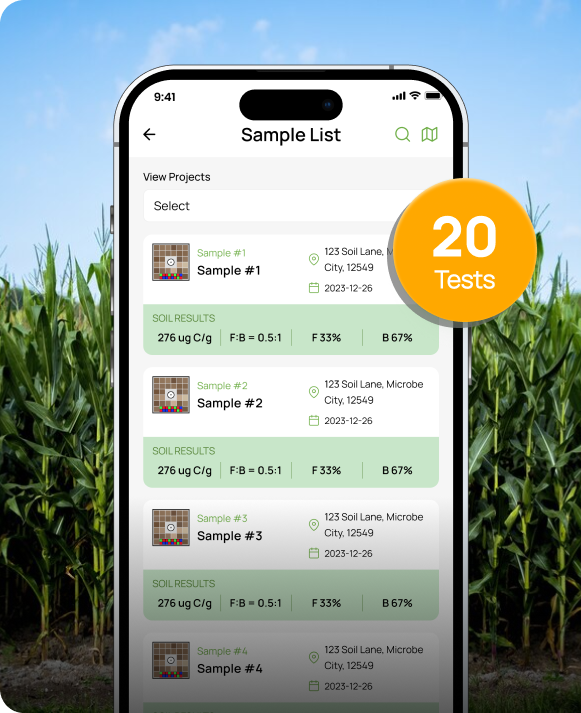
microBIOMETER® is a rapid, on-site soil test that measures soil microbial biomass and fungal to bacterial ratio (F:B) using patented smartphone technology. It can be used directly on soil and soil-based compost. The app features sample geolocation and cloud-syncing ability, enabling growers and consultants to visualise and track the success of their soil health.

This starter pack has 20 sample test cards and 20 sachets of reagent. The pack includes a whisker mixer, soil sampler and a soil sifter. The patented microBIOMETER test only takes around 10 minutes to perform, yet accuracy is on par with lab tests costing 10 times as much. Mix sifted soil for 30 seconds in the reagent solution, let it settle for 10 minutes, place 3 drops on our test card, scan it with our smart phone app, and you are done - it really is that simple! Results are archived and accessible in the cloud.

Soil health is the topic of much discussion but until now, there has not been any simple way to give an objective measure. The microBIOMETER is the answer. Microbial biomass is the best single indicator of soil health and fertility - LIFE in the soil!   (Doran, 2000).The microBioMeter in conjunction with a smartphone app provides a single number which can be used for decision making. The new app also gives the ratio of fungal to bacterial microbes. The app also provides a GPS location and the date/time when accessed.

You cant manage what you dont measure. Knowing the microbial biomass of the soil in each field enables the wise farmer to evaluate the effect of manures, cover crops, microbial inoculants, fertilisers, cultivation practices, etc. Have you measured yours recently? Further information can be found at here. Please contact us for further details.

Unlock the secrets of your soil's fertility and take the guesswork out of your soil management practices.

More Information

What is the microBIOMETER® PRO?

The microBIOMETER® PRO is a rapid, on-site soil test that measures soil microbial biomass and the fungal to bacterial ratio (F:B) using patented smartphone technology. It works directly on soil and soil-based compost, and you don't need a lab.

How it works

Soil microbes produce a natural binding substance that glues soil particles into stable aggregates. The patented method frees the microbes from the soil, the heavier particles settle out, and the soil-coloured microbes stay suspended in the liquid. A few drops go onto a test card, and the smartphone app measures the colour intensity against a comparator on the card.

Key features and benefits

  • Fast, on-site results: no sending samples away and waiting weeks.
  • Two key measurements in one test: total microbial biomass, plus the fungal to bacterial ratio (shown as F:B, F% and B%).
  • Lab-grade accuracy: the method was validated against microscopy and carbon fumigation.
  • Works on soil and soil-based compost: also suits turf, trees and Johnson-Su compost bioreactors.
  • Moisture adjustment: results assume 20% moisture for soil and 40% for compost, and you can switch to a drier or wetter setting in the app.
  • Calculated metrics: estimates of biological carbon and nitrogen per acre or hectare, worked out from your result.
  • Sample geolocation: save the sample location in the field and run the test later.
  • Cloud syncing: results and locations are stored in a cloud portal, where you can view, edit and export to Excel. The app works without WiFi or signal and syncs when you're back online.
  • Test card designed for consistency: the PRO card reduces variation between phone models and lighting conditions.

Best practice

  • Use it to set a baseline, then retest to see whether your management is working.
  • Test field-moist soil. Dry soil normally reads lower, because 20% to 80% of microbes die or go dormant as soil dries.
  • Keep conditions consistent between tests (same phone, same lighting, same sampling depth).
  • Test the same day if possible. Samples keep in a sealed bag for up to 72 hours, or refrigerated for up to 4 weeks.

When to test

  • Cover crops: before planting, and again 3 to 4 weeks later.
  • Liquid amendments: before application, then at 2 and 6 weeks.
  • Solid amendments: before application, then at 4 and 8 weeks.
  • Fertiliser inputs: before application and a week later. A drop in biomass suggests too much fertiliser.
  • Mycorrhizal inoculation: test before adding, then the rhizosphere 3 to 4 weeks later, and compare F:B with non-rhizosphere soil.
  • General: a few times each season, before and after harvest, and after the first hard frost.

What's in the kit

  • 20 PRO test cards
  • 20 reagent packets
  • 10 reusable extraction vials
  • 10 reusable pipettes
  • 2 soil sifters
  • Whisker and probe
  • Soil sampler
  • Capped measurer
  • Spatula
  • Magnet (for iron-rich clay soils)
  • Testing platform

Good to know

  • The PRO tests soil and compost, but not compost teas or extracts directly.
  • It cannot be used directly on water, manure, molasses, coir, clay pellets, rice hulls, wood chips or perlite.
  • Vials and pipettes can be rinsed and reused. 50-test refills are available from Harvest Agri.

Specifications
  • Measures: microbial biomass and fungal to bacterial ratio (F:B, F% and B%)
  • Calculated metrics: biological carbon and nitrogen (lbs/acre and kg/hectare)
  • Suitable for: soil and soil-based compost (not compost tea or extracts)
  • Test time: approximately 20 minutes (30 second mix, 20 minute settle, scan 2 minutes after applying the drops)
  • Sample size: 0.5 ml compacted soil per test
  • Readout: smartphone app (iPhone and Android)
  • Default moisture assumption: 20% soil, 40% compost (adjustable to 10% or 30% for soil, 30% or 50% for compost)
  • Data: geolocation, cloud portal, Excel export, works offline
  • Validation: microscopy (r = 0.96) and carbon fumigation (r = 0.94)
  • Reagent: sodium chloride and calcium chloride, with no safety hazards at these quantities
  • Storage: 40°F to 95°F (4°C to 35°C). Reagent packets do not expire if the packaging is intact.
  • Requires: tap or distilled water and a smartphone
  • Kit contents: 20 test cards, 20 reagent packets, 10 vials, 10 pipettes, 2 sifters, whisker and probe, soil sampler, capped measurer, spatula, magnet, testing platform
What Does The Reading Mean?

A quick recap

The microBIOMETER® is a low-cost, repeatable soil test that measures soil fertility and soil health, carried out on-farm in around 20 minutes. Mix your soil sample with the reagent, leave it to settle, then place three drops of the settled liquid onto a test card. Scan the card with the smartphone app and you get an instant read-out of microbial biomass, including the fungal to bacterial (F:B) ratio.

It's a highly practical way to benchmark fertility and soil health, and to measure the effect of practices such as no-till, cover crops and inoculants as you move towards a more sustainable and productive farming system.

I've got a result. So what?

The microBIOMETER® is a benchmarking tool. The trend over time matters more than any single number. Higher microbial biomass and a healthy F:B ratio generally mean your soil is becoming more biologically active.

Steps to make sense of your results

  1. Record the basics. Note the field, depth, date, weather and moisture, and whether the soil was dry or rewetted before sampling.
  2. Read the two headline numbers. Microbial biomass shows how much living microbial matter is in the soil. The F:B ratio shows the balance between fungi and bacteria.
  3. Compare against the range chart. Find your biomass reading on the bottom axis, then check whether your F:B falls below, mid or above average. The ranges come from hundreds of real customer results and are a starting point, as soils vary by region and management.
  4. Set a baseline. Test each field or zone first, at the same depth and time of year.
  5. Retest after changes. Test again after cover crops, amendments, inoculants, fertiliser or cultivation changes.
  6. Look at the direction. A rise in biomass and F:B suggests your approach is working. If biomass drops after fertiliser, you may have applied too much.
  7. Check the calculated metrics. The app converts your result into estimated biological carbon and nitrogen per acre or hectare.
  8. Keep it consistent. Use the same phone, lighting, depth and sampling method every time.

Things that affect readings

  • Moisture: dry soil reads lower, so note it if you rewet a sample area.
  • Seasonal swings: microbial life fluctuates naturally, which is why a baseline matters.
  • PRO vs Classic: the two use different units and assumptions, so don't compare absolute values between them.
  • Debris in the pipette: floating particles can skew the reading.
  • Scanning time: scan at the 2 minute mark.

Now, how do I IMPROVE my soil health?

Once you know where you're starting from, the next step is building your soil biology. Harvest Agri supplies FERTI-LINK probiotic rhizobacteria to kick-start your programme.

Why microbes matter

  • Crops produce exudates that attract bacteria and fungi to the rhizosphere, and the nutrients they bring stimulate plant growth.
  • Other bacteria enter the root and swap nutrients with the plant for carbon products from photosynthesis.
  • Plants can get as much as 40 per cent of their nitrogen requirement through bacterial associations.
  • Higher microbial biomass increases the nutrients naturally available to plants, enabling you to reduce application of synthetic fertilisers by at least 25% if organic material is present. Heavy fertiliser use can inhibit root growth, because the plant no longer seeks out its microbial partners for nitrogen.

Benefits of FERTI-LINK

  • Healthier plants growing in healthier soil
  • Better nutrient uptake and a reduced need for chemical fertiliser (start with a 25% reduction)
  • Greater disease resistance and a lower need for chemical pesticide, by inducing the plant's natural defence mechanism
  • Greater resistance to drought, heat and cold, thanks to a healthier, stronger, deeper root system
  • Naturally increased soil fertility
  • A natural organic product with positive benefits for the environment and no risk to humans, animals or birds
  • Costs less than £20 per hectare, making it a very affordable biostimulant treatment

Using FERTI-LINK

  • Available in 50 ml and 1 litre bottles
  • One application needs only 50 ml per hectare, as it is highly concentrated
  • A soil treatment suitable for almost all crops, provided some organic material is present
  • Can be applied with a high pressure sprayer, together with liquid fertiliser or most pesticides (other than copper fungicides)
  • Supplied direct to farmers

View FERTI-LINK and our other Organic Inputs >>