
Share
Feeding the Soil or Feeding the Crop? Microbial vs Synthetic Chemistry
Jack IngleYou have applied the right fertiliser at the right rate, yet the crop still looks tired. Before buying more product, it is worth asking a different question: is your soil biology able to make use of what you are giving it?
Two very different ways of feeding a crop
Synthetic fertiliser works by supply. Soluble nutrients are placed in the soil, and the plant takes them up directly. The effect is fast and predictable, which is why it is so widely used.
Microbes work by partnership. Crops release exudates from their roots that attract bacteria and fungi to the rhizosphere, and the nutrients these organisms bring stimulate plant growth. Some bacteria even enter the root and swap nutrients with the plant in return for carbon products from photosynthesis. Plants can get as much as 40% of their nitrogen requirement through these bacterial associations.
This is where the two approaches diverge. Synthetic inputs act on the crop. Microbes act on the soil, and through the soil, on every crop that follows.
There is also a cost to heavy fertiliser use. When nitrogen is supplied in abundance, the plant no longer needs to seek out its microbial partners, and root growth can be inhibited as a result. The biology goes unused, and the system becomes more dependent on bought-in inputs.
Measuring what is happening below ground
Most growers know their soil's pH, phosphorus and potassium. Far fewer know how much life it holds. The microBIOMETER fills that gap.
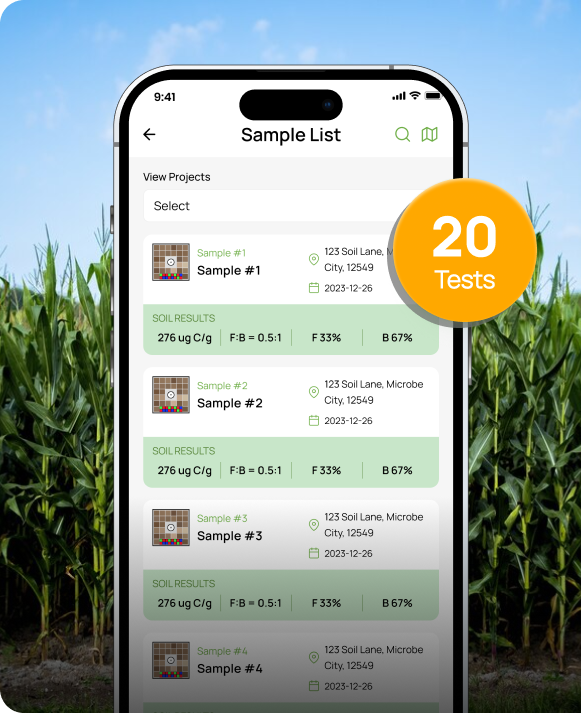
It is a low-cost, repeatable test carried out on the farm in around 20 minutes. You mix a soil sample with the reagent, leave it to settle, place three drops of the settled liquid onto a test card and scan it with the smartphone app. The result is an instant read-out of microbial biomass and the fungal to bacterial (F:B) ratio.
It is a practical way to benchmark fertility and soil health, and to measure the effect of practices such as no-till, cover crops and inoculants as you move towards a more sustainable and productive system.
I have a result. So what?
The microBIOMETER is a benchmarking tool, and the trend over time matters far more than any single number. Higher microbial biomass and a healthy F:B ratio generally mean your soil is becoming more biologically active.
Here is how to make sense of your results.
- Record the basics. Note the field, depth, date, weather and moisture, and whether the soil was dry or rewetted before sampling.
- Read the two headline numbers. Microbial biomass shows how much living microbial matter is in the soil. The F:B ratio shows the balance between fungi and bacteria.
- Compare against the range chart. Find your biomass reading on the bottom axis, then check whether your F:B falls below, mid or above average. The ranges come from hundreds of real customer results and are a starting point, because soils vary by region and management.
- Set a baseline. Test each field or zone first, at the same depth and time of year.
- Retest after changes. Test again after cover crops, amendments, inoculants, fertiliser or cultivation changes.
- Look at the direction. A rise in biomass and F:B suggests your approach is working. If biomass drops after fertiliser, you may have applied too much.
- Check the calculated metrics. The app converts your result into estimated biological carbon and nitrogen per acre or hectare.
- Keep it consistent. Use the same phone, lighting, depth and sampling method every time.
Things that can affect your readings
- Moisture: dry soil reads lower, so make a note if you rewet a sample area.
- Seasonal swings: microbial life fluctuates naturally, which is why a baseline matters.
- PRO versus Classic: the two versions use different units and assumptions, so do not compare absolute values between them.
- Debris in the pipette: floating particles can skew the reading.
- Scanning time: scan at the two minute mark.
Now, how do you improve your soil health?
Once you know where you are starting from, the next step is building your soil biology. Ferti-Link probiotic rhizobacteria is a good way to kick-start your programme.
Higher microbial biomass increases the nutrients naturally available to plants. According to our guidance, this allows you to reduce synthetic fertiliser by at least 25% where organic material is present, and Ferti-Link is designed to support that shift.
What Ferti-Link offers
- Healthier plants growing in healthier soil
- Better nutrient uptake and a reduced need for chemical fertiliser, starting with a 25% reduction
- Greater disease resistance, by inducing the plant's natural defence mechanism, which can lower the need for chemical pesticide
- Greater resistance to drought, heat and cold, thanks to a stronger, deeper root system
- Naturally increased soil fertility
- A natural organic product with positive benefits for the environment
- A treatment costing less than £20 per hectare
Using Ferti-Link
- Available in 50 ml and 1 litre bottles
- One application needs only 50 ml per hectare, as it is highly concentrated
- A soil treatment suitable for almost all crops, provided some organic material is present
- Can be applied with a high pressure sprayer, together with liquid fertiliser or most pesticides (other than copper fungicides)
- Supplied direct to farmers
Measure, act, measure again
The sequence is simple. Measure your microbial biomass and F:B ratio, understand what the result says about your soil, act with management changes and biological inputs, then retest to confirm the soil is responding.
A soil that is alive reduces your reliance on bought-in inputs over time. A soil that is not measured leaves you guessing.
To start benchmarking your soil biology, get in touch with Harvest Agri about the microBIOMETER PRO Starter Kit, which includes supplies for 20 tests, and view our range of organic inputs, including Ferti-Link.